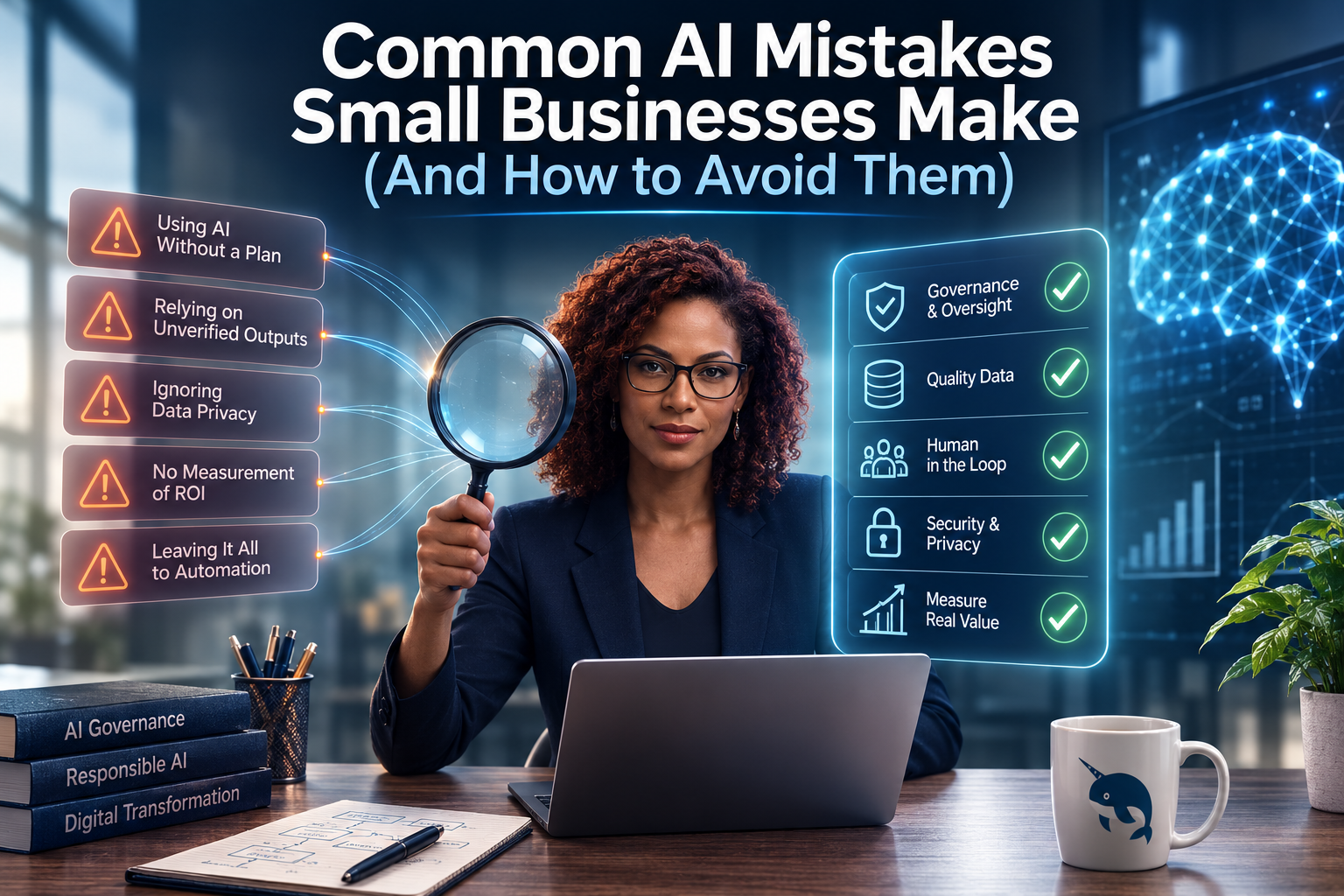
Artificial intelligence is becoming more accessible to small businesses — but access doesn’t guarantee results.
In fact, many small businesses struggle with AI not because they ignore it, but because they implement it the wrong way.
The good news is that most AI mistakes are predictable — and avoidable.
What are the most common AI mistakes small businesses make?
The most common AI mistakes include starting with tools instead of strategy, ignoring data risks, trying to do too much too quickly, and lacking clear guidelines for how AI should be used.
These mistakes often lead to wasted time, unnecessary costs, and inconsistent results.
1. Starting with tools instead of strategy
Many businesses begin by experimenting with tools like ChatGPT, automation platforms, or AI plugins without first defining what they want to achieve.
Why this is a problem
- No clear direction
- Random use cases
- Difficult to measure value
What to do instead
Start by identifying:
- Where your business needs efficiency
- Where time is being lost
- Where AI can support existing workflows
>>>Related: AI Strategy for Small Businesses: A Practical Guide
2. Ignoring data privacy and risk
AI tools are often used without clear rules around what data can be entered or shared.
Why this is a problem
- Sensitive data may be exposed
- No visibility into how tools handle information
- Increased business and client risk
What to do instead
- Define clear boundaries for data usage
- Limit which tools are approved
- Educate your team on safe usage
>>>Related: AI Risks for Small Businesses (And How to Avoid Them)
3. Trying to do too much too quickly
AI can feel like an opportunity to transform everything at once.
Many businesses attempt:
- Multiple automations
- Multiple tools
- Multiple workflows
All at the same time.
Why this is a problem
- Overwhelm
- Poor adoption
- Lack of measurable results
What to do instead
Start with:
- 1–2 high-impact use cases
- Clear success metrics
- A focused rollout
Build momentum before expanding.
4. Lack of clear guidelines or governance
Without basic structure, AI usage becomes inconsistent across teams.
Why this is a problem
- Different people use AI in different ways
- No accountability
- No consistency in outputs
What to do instead
Create simple, practical guidelines:
- What AI can be used for
- What requires review
- What tools are approved
5. Over-relying on AI outputs
AI can generate content, insights, and recommendations — but it is not always correct.
Why this is a problem
- Incorrect information may be used
- Brand voice becomes inconsistent
- Decision quality may decline
What to do instead
- Keep humans involved in key decisions
- Review outputs before using them externally
- Treat AI as support, not authority
6. Adopting too many tools
The AI landscape is constantly evolving, and it’s easy to accumulate tools without a clear purpose.
Why this is a problem
- Increased costs
- Overlapping functionality
- Lower adoption
What to do instead
- Focus on a small number of tools
- Align tools to specific use cases
- Review usage regularly
7. Not understanding how AI is already being used
In many businesses, AI adoption happens informally.
Employees may already be:
- Using ChatGPT
- Testing tools
- Automating tasks
Without visibility from leadership.
Why this is a problem
- Hidden risks
- Missed opportunities
- Lack of coordination
What to do instead
Start by identifying:
- Where AI is currently being used
- Which tools are in play
- What data is being shared
>>>Related: How to Audit AI Usage in Your Business
How to avoid these mistakes
Avoiding AI mistakes does not require a complex system.
It requires:
- Clarity (what is happening today)
- Focus (where to start)
- Structure (basic guidelines)
Small improvements in these areas can significantly improve results.
Final thoughts
AI can absolutely help small businesses operate more efficiently and grow.
But success does not come from using more tools.
It comes from:
- Making better decisions
- Applying AI in the right places
- Avoiding common pitfalls
When you avoid these mistakes, AI becomes a practical advantage — not a source of confusion.
Want help avoiding these mistakes?
If you want to understand where your business may be making these mistakes — and how to fix them — start with an AI Trust Review.
You’ll get:
- A clear picture of current AI usage
- Identification of gaps and risks
- Practical recommendations
- A focused action plan