SEO title: The AI Reality Gap: Why Capable AI Systems Fail in the Wild
Meta description: AI systems that look capable on paper often fail in production because benchmark results do not automatically transfer to real-world deployment conditions. Here is why the AI reality gap matters.
The Dangerous Translation Error Between the Lab and the Boardroom
As an AI researcher and strategist, I constantly observe a dangerous translation error between the technical lab and the corporate boardroom.
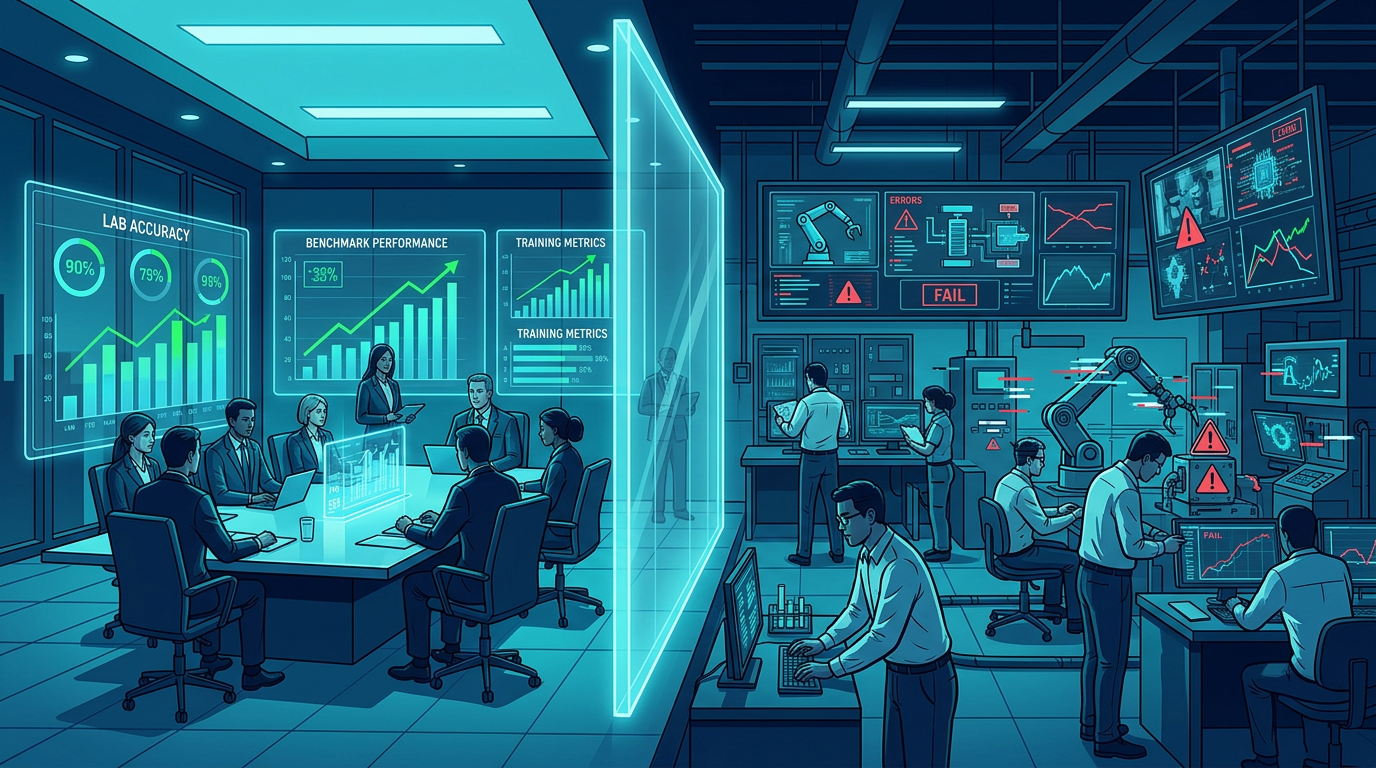
Machine learning teams evaluate systems in controlled, idealized environments using pristine benchmark metrics. Executives then procure and deploy those same systems into complex, unpredictable, and highly stressed operational realities, assuming those pristine metrics will seamlessly transfer.
They rarely do.
When a multi-million-dollar AI initiative fails, the culprit is rarely a sudden algorithmic mystery. It is a measurement error. We are assessing capability at one level of abstraction and making high-stakes deployment decisions at another.
What the AI Reality Gap Really Means
The AI reality gap is the distance between what a system appears able to do under evaluation conditions and what it can reliably do inside an actual organization.
A vendor demonstration may show high accuracy. A benchmark may show strong performance. A pilot may succeed under careful supervision. But those signals do not automatically prove that the system will perform under your operating conditions, with your data, your people, your incentives, your edge cases, and your pace of change.
The problem is not that benchmark metrics are useless. The problem is that organizations often treat benchmark metrics as deployment forecasts. They are not. They are evidence about performance under a specific set of conditions.
Why Systems That Are Capable on Paper Fail in the Wild
My latest working paper, recently submitted to SSRN, introduces a pre-deployment diagnostic framework designed to bridge this gap. It maps well-established machine learning failure modes directly to their real-world corporate triggers, including scope creep, integration degradation, and use-condition divergence.
The central question is simple: under what exact conditions was this AI capability established, and how closely do those conditions match the environment where the system will actually operate?
That question is often missing from AI procurement, risk review, and executive approval processes. Without it, organizations can end up buying a system that is capable in the abstract but fragile in context.
Five Pathways Where AI Capability Degrades
The research identifies five distinct pathways where AI capability can degrade between evaluation and deployment.
1. Distribution Shift
The inputs the system sees in production differ from the inputs it saw during testing. Even small changes in data quality, format, customer behavior, lighting, language, timing, or process context can reduce performance.
2. Integration Degradation
The system does not operate alone. It connects to workflows, databases, downstream decisions, human teams, and other tools. A model that performs well in isolation may become unreliable once its outputs move through a larger operational chain.
3. Scope Creep
The task demanded in production quietly expands beyond the task demonstrated in evaluation. A system tested on a narrow use case may later be asked to handle broader, messier, and more ambiguous work.
4. Temporal Degradation
The world changes while the system remains static. Customer behavior shifts, markets move, product lines change, regulations evolve, and data patterns drift. Capability that was real at launch can decay over time.
5. Use-Condition Divergence
Real users under real pressure behave differently from evaluators in controlled settings. Employees work around systems, customers phrase requests unpredictably, and operational stress changes how tools are used.
Why This Matters for AI Governance
AI governance is not only about policy. It is also about measurement. If an organization measures one thing and makes decisions as if it measured another, governance becomes performative rather than protective.
The AI reality gap is especially dangerous because it can remain invisible until after a contract is signed, a workflow is redesigned, or a workforce decision has already been made. By then, the organization is no longer evaluating a capability claim. It is managing operational damage.
A pre-deployment diagnostic helps decision-makers stress-test AI claims before the commitment becomes expensive, public, or difficult to reverse.
Implementing the Capability Lens
The capability lens is useful for both research and enterprise decision-making.
- For academics and researchers: if your focus is on AI measurement, evaluation metrics, or governance frameworks, this methodology offers a way to connect technical failure modes to organizational decision points.
- For enterprise executives and risk officers: if you are looking to audit vendor claims and stress-test AI deployments before signing a contract, this diagnostic instrument can be integrated into the procurement lifecycle.
The goal is not to make AI adoption slower. It is to make AI adoption more accurate. Organizations should be able to distinguish between systems that are impressive in demonstration and systems that are ready for the conditions in which they will actually be used.
Closing the AI Reality Gap
The full presentation, Closing The AI Reality Gap, details the five pathways where AI capability degrades and illustrates them through a high-stakes enterprise deployment that looked flawless on paper but ultimately collapsed in production.
You can view the presentation here: Closing The AI Reality Gap.
To explore how to implement pre-deployment diagnostic controls within your organization, visit thebluenarwhal.com.
JM Wofford is the founder of The Blue Narwhal, an AI governance advisory practice and a professor of computer science. Their work focuses on AI measurement, governance, procurement readiness, and responsible deployment in real-world organizations.