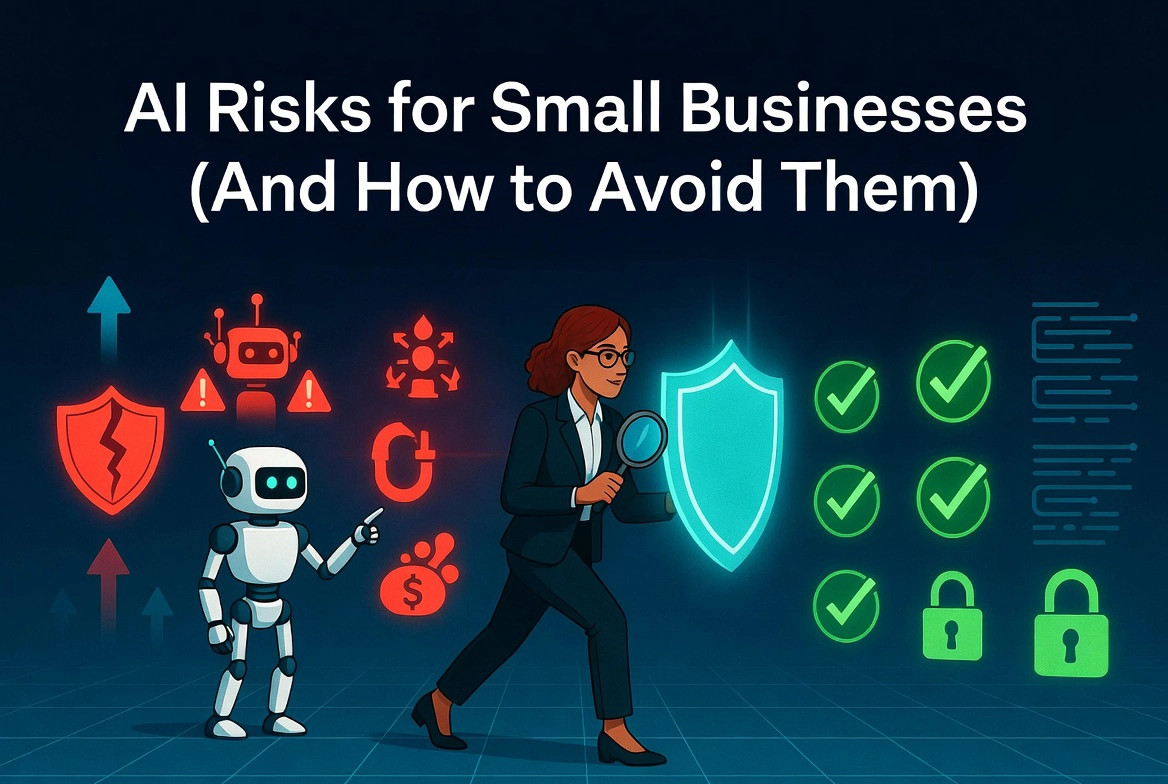
Artificial intelligence is becoming part of everyday business operations — from marketing and customer support to internal workflows and decision-making.
But while AI creates opportunity, it also introduces real risks that many small businesses don’t fully understand until it’s too late.
The goal isn’t to avoid AI. It’s to use it safely, intentionally, and with the right guardrails in place.
Most small businesses start with strategy, discover risks, and then move into auditing their current usage.”
The goal is to use AI with a clear structure — which is why having an overall AI strategy matters.
>>> If you haven’t defined that yet, start with AI Strategy for Small Businesses: A Practical Guide.
What are the biggest AI risks for small businesses?
The biggest AI risks for small businesses fall into four main categories: data exposure, inconsistent outputs, lack of control, and over-reliance on tools.
These risks often go unnoticed because AI adoption tends to happen informally — one tool, one workflow, one team member at a time.
1. Data privacy and confidentiality risks
One of the most common — and most serious — risks is how data is used inside AI tools.
Many businesses do not realize:
- Employees may be entering sensitive customer or business data into AI platforms
- That data may be stored, processed, or reused depending on the tool
- There are often no internal guidelines around what is acceptable
Why this matters
Even small mistakes can expose:
- Client information
- Financial data
- Internal strategy
How to reduce this risk
- Define what data can and cannot be used in AI tools
- Approve a limited set of tools for business use
- Train your team on safe usage
2. Inconsistent and unreliable outputs
AI can produce useful results — but it is not always accurate.
Without oversight, this leads to:
- Incorrect information being shared with customers
- Poor-quality marketing content
- Misinterpretation of data
Why this matters
AI outputs can sound confident even when they are wrong.
This creates:
- Brand risk
- Customer trust issues
- Internal confusion
How to reduce this risk
- Require human review for important outputs
- Define where AI can be used vs. where it cannot
- Create simple quality standards
3. Lack of visibility and control
In many small businesses, AI usage is decentralized.
Different team members may:
- Use different tools
- Apply AI in different ways
- Work without shared guidelines
Why this matters
This creates:
- Duplicate tools and costs
- Inconsistent processes
- No clear accountability
How to reduce this risk
- Identify where AI is already being used
- Centralize decisions around tools and workflows
- Assign ownership for AI-related decisions
👉 Related: How to Audit AI Usage in Your Business
4. Tool overload and wasted spend
The AI landscape changes quickly, and it’s easy to adopt too many tools without a clear purpose.
This leads to:
- Paying for tools that are not fully used
- Overlapping functionality
- Increased complexity
Why this matters
More tools do not equal better results.
In many cases, they create:
- More confusion
- Lower adoption
- Higher costs
How to reduce this risk
- Start with a small number of high-value use cases
- Choose tools based on needs, not trends
- Regularly review what is actually being used
5. Over-reliance on AI
AI is a support tool — not a replacement for judgment.
Some businesses begin to:
- Rely on AI for decisions without validation
- Use AI-generated content without review
- Reduce critical thinking in workflows
Why this matters
Over-reliance can lead to:
- Poor decisions
- Loss of brand voice
- Reduced quality
How to reduce this risk
- Keep humans in the loop for key decisions
- Define where AI supports vs. where it should not lead
- Encourage critical review of outputs
6. Lack of governance and clear policies
Many small businesses operate without any formal AI guidelines.
This means:
- No shared understanding of acceptable use
- No consistency across teams
- No protection against avoidable mistakes
Why this matters
Without governance, AI usage becomes unpredictable and harder to manage over time.
This is where a structured approach becomes critical. A well-defined strategy helps prevent these issues before they start.
>>>See AI Strategy for Small Businesses for how to build that foundation.
How to reduce this risk
- Create simple, practical AI usage guidelines
- Define roles and responsibilities
- Document basic policies that your team can follow
How to identify AI risks in your business
If you’re unsure whether these risks apply to you, ask:
- Do you know which AI tools your team is using?
- Do you know what data is being entered into those tools?
- Are there guidelines for how AI should be used?
- Are outputs reviewed before being used externally?
If the answer to any of these is unclear, there is likely some level of risk present.
How to approach AI safely (without slowing down your business)
The goal is not to eliminate risk completely — that’s not realistic.
Instead, focus on:
- Awareness (what’s happening today)
- Control (basic guardrails and decisions)
- Prioritization (what matters most)
You don’t need a complex system.
You need a clear one.
Common mistakes small businesses make with AI risk
Ignoring risk because “we’re small”
Size does not eliminate exposure.
Assuming tools are safe by default
Every tool has different rules and behaviors.
Overcomplicating governance
Policies should be simple and usable — not overwhelming.
Waiting too long to address it
The longer AI usage grows without structure, the harder it is to manage.
Final thoughts
AI can absolutely help your business operate more efficiently and grow.
But without basic awareness and structure, it can also introduce risk that is difficult to see — and harder to fix later.
The goal is not fear.
It’s control.
When you understand how AI is being used and put simple guardrails in place, you can move forward with confidence.
Want a clear picture of your AI risk?
If you want to understand where your business may be exposed — and what to do about it — start with an AI Trust Review.
You’ll get:
- A clear view of current AI usage
- Identification of potential risks
- Practical recommendations
- A prioritized action plan
This gives you the foundation to move forward safely and effectively.
It also ensures your AI efforts are aligned with your broader business goals — not just reacting to risk.
>>> Learn how to build that alignment in AI Strategy for Small Businesses.
Related resources
- AI Strategy for Small Business: A Practical Guide
- How to Audit AI Usage in Your Business
- Common AI Mistakes Small Businesses Make