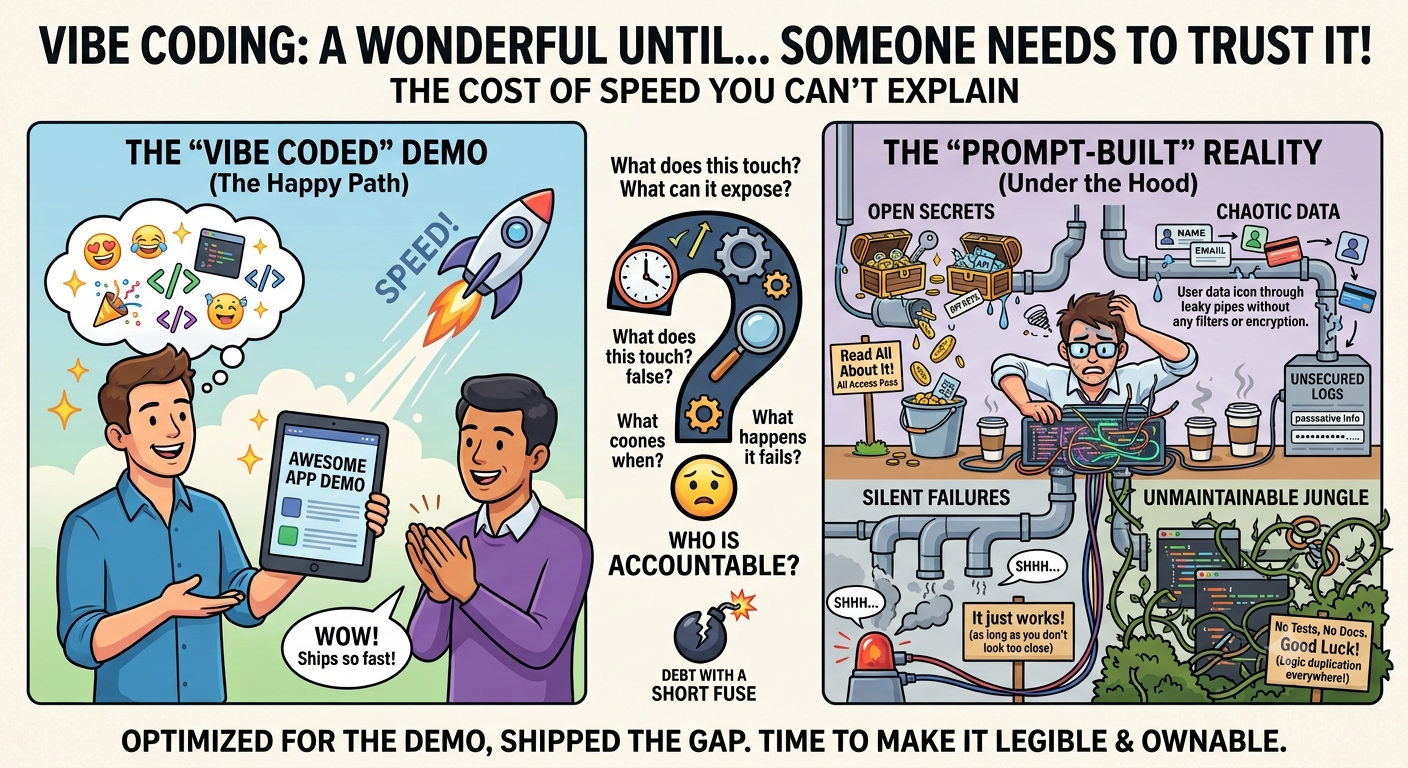
AI adoption in small businesses is accelerating—but not in the way most frameworks assume.
It’s not happening through formal programs, structured rollouts, or governance committees.
It’s happening through what is called “vibe coding.”
This is the emerging pattern where business owners and teams use AI tools, prompts, and low-code platforms to rapidly build capabilities—often without formal design, testing, or oversight. It’s intuitive, fast, and highly accessible.
It’s also introducing a new category of unmanaged risk.
The Reality of AI Adoption in Small Business
Most small businesses are not approaching AI as a transformation initiative. They’re approaching it as a utility.
- Generate content faster
- Automate repetitive tasks
- Improve responsiveness to customers
- Experiment with new capabilities at low cost
This is rational. It’s efficient. And in many cases, it creates immediate value.
But it also bypasses the structures that traditionally ensure systems are reliable, secure, and aligned with business intent.
Where “Vibe Coding” Breaks Down
The issue isn’t the use of AI—it’s the absence of operational discipline around it.
Common failure points include:
- Uncontrolled data exposure through prompts and integrations
- Inconsistent or non-deterministic outputs in customer-facing scenarios
- Lack of traceability in AI-influenced decisions
- No defined ownership or accountability for AI-driven processes
In enterprise environments, these are addressed through governance frameworks. In small businesses, they are often invisible until they create a material problem.
A Practical Governance Layer for Small Teams
Small businesses do not need enterprise-scale governance. They do need intentional controls.
A lightweight, effective approach includes:
- Prompt management as a discipline
Treat prompts as reusable assets tied to specific business functions. Standardize and review them where risk is present. - Explicit data boundaries
Define what data is permissible for use in AI systems and what is not. This alone mitigates a significant portion of risk. - Human oversight by design
Ensure that high-impact outputs—especially those affecting customers or decisions—are reviewed before execution. - AI use case visibility
Maintain a simple inventory of where AI is being used. Visibility enables accountability and improvement.
The Strategic Implication
Speed is no longer the differentiator. Access to AI tools has already commoditized that.
The differentiator is trust.
Organizations that can rely on their AI systems—because they understand them, control them, and can explain them—will be the ones that scale successfully.
“Vibe coding” is not the problem. It is the starting point.
The next step is operationalizing it.